Notes from the Trenches // Reading the recoil
Tuning into the Distortion Field
A distortion field is not a spell. It is an exertion of force, and force cannot be spent without leaving a wave. This is an account of learning to read the wave instead of the microphone.
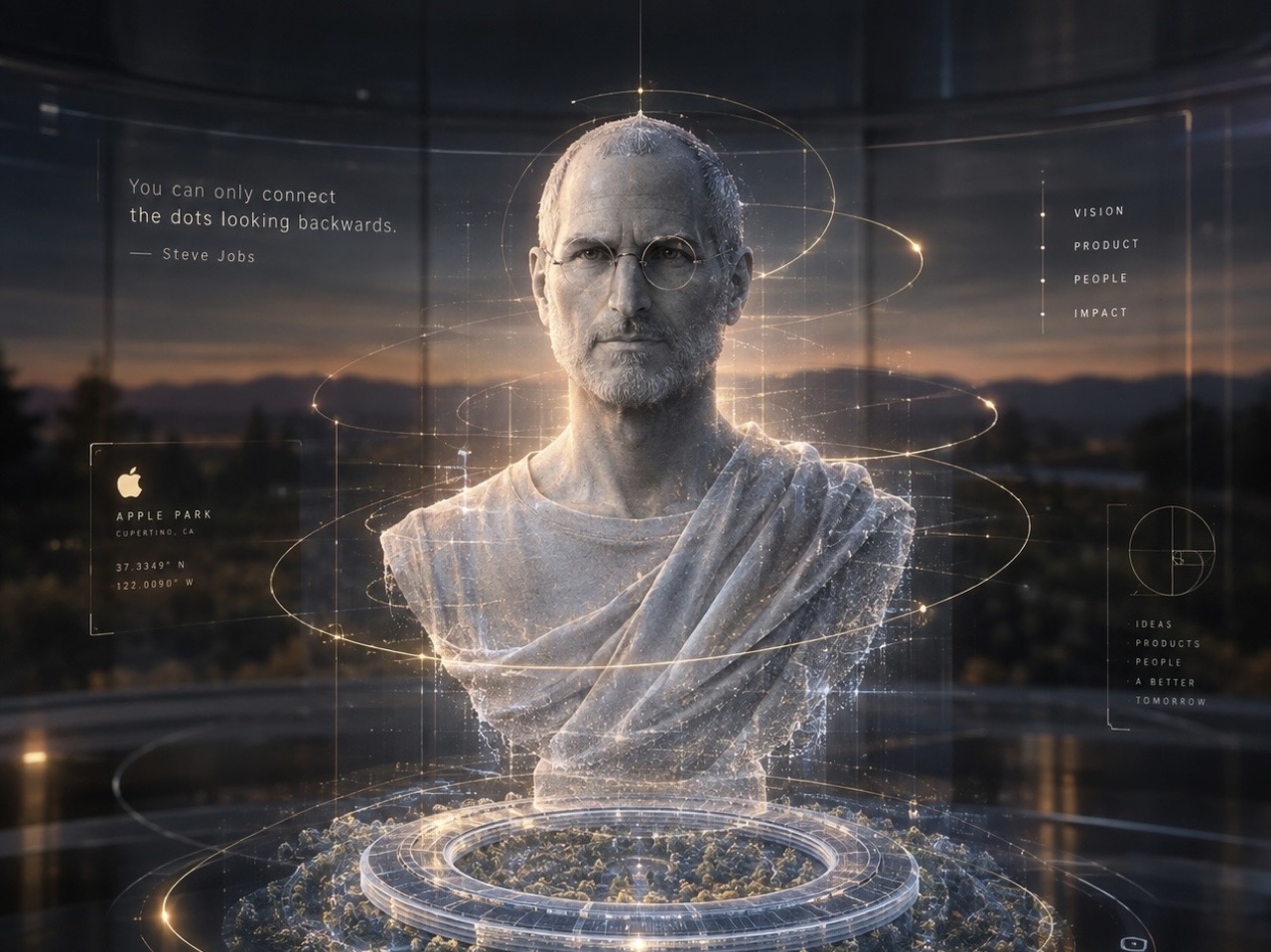
The minute you understand that you can poke life, and that if you push in, something will pop out the other side, that you can change it, you can mold it. That's maybe the most important thing. Steve Jobs, 1994 · Santa Clara Valley Historical Association
In 1981, Bud Tribble coined the phrase reality distortion field to describe what it was like to work near Steve Jobs: the ability to convince a room that an impossible deadline was easy, that an unbuilt system was already finished, that fatigue did not apply. For forty years the tech world filed that under charisma, a theatrical spell cast from a keynote stage. That was a category error.
A distortion field is not magic. It is an exertion of immense organizational energy, and like any force in nature it obeys a conservation law: you cannot bend reality without generating back-pressure. Bend a room of people and they nod. Bend the laws of semiconductor physics, thermal dissipation, battery chemistry, and sensor latency, and reality does not yield. It pushes back. The pressure has to go somewhere. It compresses into things you can actually measure: supply-chain balance sheets, patent clusters, hardware reorganizations.
When a wave hits a wall it does not die. It recoils. The whole method is learning where the energy went.
For a decade, Apple's Project Titan was where the field met the wall. Reporting put the spend north of ten billion dollars and the team in the thousands before Apple wound it down in early 2024. That money did not vanish into a car that never shipped. It was driven into the granite of automotive physics by engineers asked to bridge an impossible gap: a vehicle with no steering wheel, silent operation, sensor fusion with reflexes measured in milliseconds, all held to a consumer margin.
They were the shock absorbers. Every time the mandate said the car was close, someone downstream had to absorb the difference in the only currency the universe accepts: a thermal budget, a wiring-harness redesign, a sensor-fusion compromise. When the project was canceled, the commentary class held an autopsy and concluded Apple was lost, aimless, and late to the generative-AI race. They were reading the microphone. They missed the recoil.
In market analysis, speed is usually the enemy of perception. The reflex is to react to the morning headline, the earnings blip, the viral clip. The mind locks up processing a thousand speculative futures instead of observing the physical present. The correction is boring and deliberate: stop listening to the keynote audio, and go look at what the pressure did to capital allocation. Capital is the one place a company cannot perform. It has to actually move the money.
On January 29, 2026, Apple spent roughly two billion dollars to acquire Q.ai, a stealth-mode Israeli startup, its second-largest acquisition ever behind Beats. The headline framing was a frantic patch for Siri. Tuned to the physical wave, the signal read differently. Q.ai does not build large language models. It builds silent speech: optical sensing that reads the micro-movements of facial muscles to infer words spoken quietly or not aloud at all. Its co-founder, Aviad Maizels, had founded PrimeSense, the depth-sensing company Apple bought in 2013 that became Face ID. This was a sensor and interface play with a decade of lineage, not a chatbot.
I wrote that read the next day, and the load-bearing tell was where the deal would have to sit. A Siri fix belongs to software. A sensor stack belongs to hardware.
The tell, as published
"If this were about 'fixing Siri,' the acquisition would sit under Craig Federighi (Software). But Q.ai is a hardware-centric sensor play. This $2B check is likely John Ternus's Mandate."
2B Poker Face, published Jan 30, 2026 on LinkedIn ↗
The same piece called the move, in as many words, not a panicked reaction; it is a coronation. The wager was not about the car and never had been. It was a claim about which side of the house the durable value would settle on when the pressure finally found its exit.
Predictions are only worth the falsifiers stated in front of them, so here are the three, checked against the public record, one of them corrected in the open.
Calibration: three dated calls
Sources: Apple Newsroom · Q3 FY26 results · Q2 FY26
The correction matters more than the wins. A ledger you can trust is one that books its own errors at the same size it books its hits, so owning the Q2 number and the Q3 tailwind is not a footnote. It is the reason the other rows are worth reading at all. The same three calls walked as a dated Bayesian ledger, and the investor-grade closing-the-loop version with its pre-mortem for the cherry-pick objection, are their own entries in the same record.
When the read went out, the response split almost evenly. Half was the public ledger anyone can see: the saves, the shares, the comments on the counter. The other half was quieter. Connection requests I had sent were accepted by people whose own profiles place them inside Apple's Special Projects Group, the team at the center of this account. I am not going to name them, none of it was a leak, and none of it is proof of anything on its own. I read it the way you read any weak signal: a small, consistent nudge that the description had landed close enough to a lived reality that the people who lived it did not wave it off. That is the only corroboration a public analyst is allowed to have, and it is worth exactly what it is. A signal, not a citation.
On September 1, 2026, John Ternus became chief executive of Apple. The reaction ran to surprise: a hardware engineer taking the seat in the middle of a software-AI cycle. But the field had already completed its arc. Once any model can be swapped for any other from a settings menu, the model is a commodity and the durable value moves back to where Apple has always compounded it: custom silicon, thermal enclosures, the sensor and interface physics that a competitor cannot copy from a weights file.
The distortion field did not break the company. It hardened the hardware group into the one team positioned to govern what comes next. The car was the cover story. The sensor stack, the succession, and the margin were the product underneath.
The method is not clairvoyance and it is not access. Every source here is public: an acquisition filing, an earnings release, a keynote, a dated post with its falsifier stated up front. The only edge is refusing to grade an institution by what its executives say on stage, and grading it instead by the standing waves thrown off when ambition collides with physics. The dates carry a second proof beyond the calibration. A read published the day after a public acquisition, off public reporting, is a read that never had an inside line: you cannot front-run a deal you learned about from the news. The timestamp is the alibi.
What a single call cannot tell you is whether the instrument is any good. That only shows in the series. Run the loop enough times, in public, with the falsifier stated in front and the misses booked at full size, and what you are measuring stops being any one prediction and becomes the quality of the inference over time. The method predates the machine that now runs it, described in prose eight months before the pipeline existed, and it predates even the vocabulary, visible as an instinct before it had a name. The discipline that makes the series legible is the same whether the subject is a custody clause or a piece of slang: name the mechanism, then state plainly what would prove you wrong, which is the whole of the pre-mortem that asked to be wrong.
Turn the keynote down. Listen for the chassis under load. The receipts are quieter than the microphone, and they do not perform.
The serialized thread · One method, seven subjects
The discipline that makes the series legible is the same whether the subject is a custody clause or a piece of slang: name the mechanism, then state plainly what would prove you wrong.
Each entry states its own falsifier. Read together they are the topography: not one call, but the inference quality across the series.